
AgTech · Deep Tech · Nanotechnology · Pre-Seed

The Nanotechnology that
Regenerates the Soil
and the Future

Smart MOFs that restore degraded soils,
boost productivity and sequester carbon.
From lab to field — scalable, sustainable, economically viable.

TRL 7
Technology Readiness
+58%
Biomass
−52%
CO₂ Emissions/kg
20+
Years of R&D
MOF TECH P&D
Scientific Foundation

What are Metal-Organic Frameworks?

The fastest-growing class of materials in chemistry worldwide — and the foundation of all MOF TECH P&D technology.

MOF structure
Nanoscale Porous Structure
Three-dimensional crystalline networks formed by coordinating metals with organic linkers. High porosity and tunable surface area.
∼1 million times smaller than a pinhead
🏆 2025 Nobel Prize in Chemistry
🧬

Porous Nanoscale Structure

MOFs are materials made by coordinating metals with organic molecules, forming ultra-porous three-dimensional networks — like a nanoscale sponge with an extraordinary surface area.

⚗️

Storage and Controlled Release

Their structure can capture, store and release substances under programmed conditions — nutrients, gases, active compounds — with precision and selectivity unique among advanced materials.

🌐

Versatile Applications

A platform technology with applications in agriculture, energy, environment, health and industry. MOFs are today the fastest-growing material in chemistry worldwide, recognized with the 2025 Nobel Prize in Chemistry.

📈

Rapidly Expanding Market

Projected growth of 12% a year over the next decade. MOF TECH P&D sits at the intersection of cutting-edge global science and the planet's largest agricultural demand.

The Problem

The Soil Is Exhausted.
So Are Conventional Solutions.

Soil degradation is the biggest barrier to sustainable productivity
and one of the main drivers of global climate change.

100M
Hectares of degraded pastureland in Brazil — with no viable recovery solution on the market today.
40%
Of the planet's soil is degraded, according to the UN — threatening food and water security on a global scale.
300 years
The time nature takes to regenerate 1 cm of soil. Artificial methods take decades. With MOFs, it takes us months.
36.3 Gt
Of CO₂ emitted globally in 2021 — a record level. Agriculture can be part of the solution, not the problem.
Our Solution

3-in-1 MOF Platform
for the Farmer's Trilemma

Proprietary formulation of metal-organic nanostructures — MOF — developed specifically for tropical soils, with a sustainable, scalable and cost-effective production process.

🌱

Higher Productivity

Controlled nutrient release restores the soil's ecosystem functions, increasing biomass by up to 58% and chlorophyll content by 74%. Results validated in controlled experiments.

💰

Lower Fertilizer Costs

Combined with the MOF, nutrient availability and uptake from the soil are enhanced, allowing up to 50% less phosphate fertilizer — with better use of applied inputs and a lower cost per hectare.

🌍

Carbon Sequestration

MOF nanostructures promote the input and stabilization of organic carbon in the soil, cutting CO₂ emissions per kg of biomass by 52%. This allows partner growers to access the growing carbon credit market — a new source of revenue per hectare.

Application Formats

Powder (solid) Spray (liquid) Biodegradable Tropical Soils Existing Equipment
0:00 / 0:00
Scientific Validation

The Soil Responds.
The Data Confirm It.

Validated in partnership with USP, UNESP and RCGI/FAPESP.
Consistent results in controlled experiments.

+58%
Increase in biomass production (sugarcane)
−52%
Reduction in CO₂ emission intensity per kg of biomass
+80%
Increase in soil microbial activity
+74%
Increase in chlorophyll content — healthier plants
TRL 7
Technology Readiness Level 7 — Demonstration in an Operational Environment
Field demonstration carried out on a UNESP experimental farm, under real tropical growing conditions.
Next step: first pilots with growers.
Featured Scientific Publication

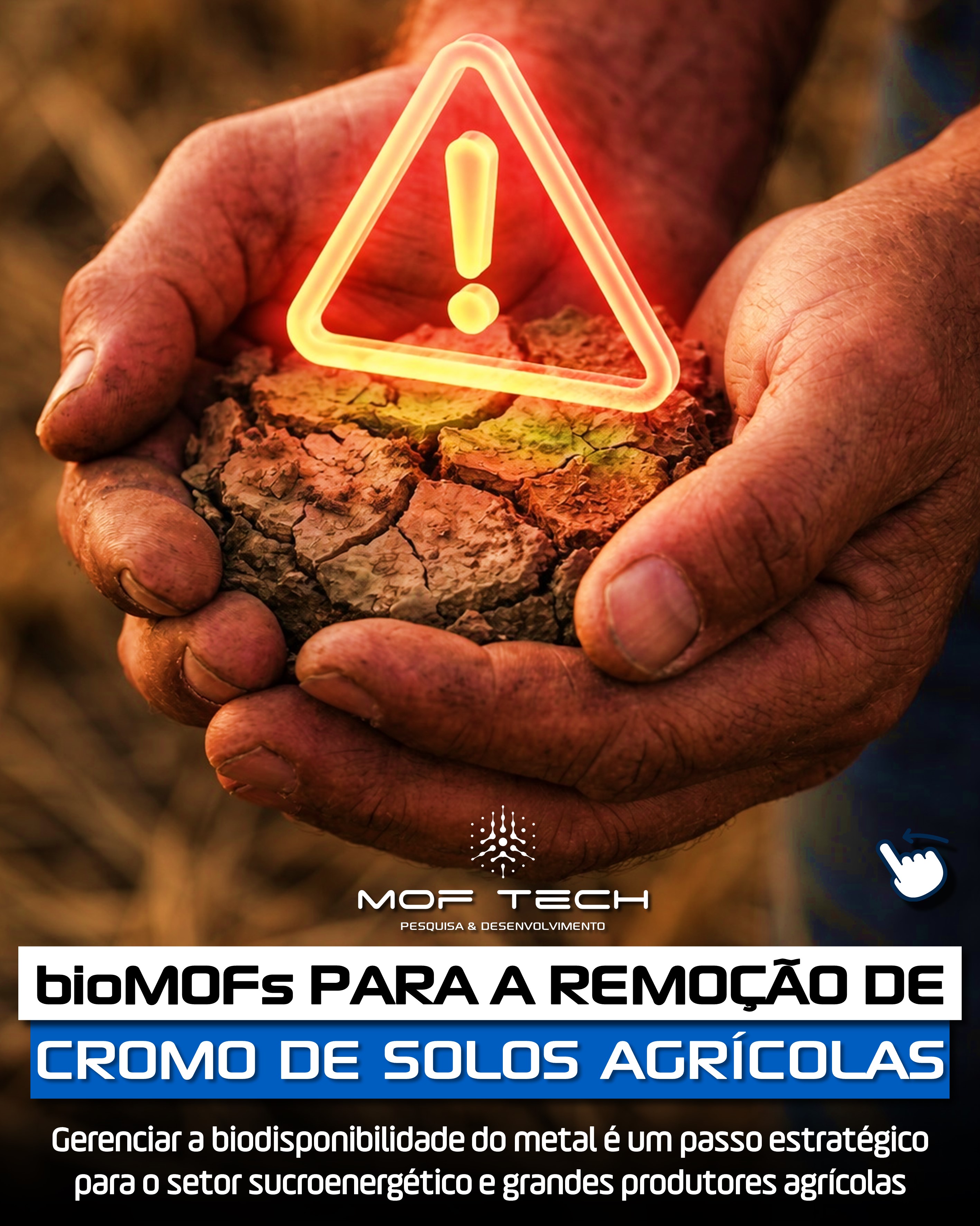
MOFs for Chromium
Remediation in Agricultural Soils

A Silent Contaminant in the Soil!
A Science-Based Solution.

Published — RSC Mechanochemistry, 2026

Removal of Chromium (VI) from Soils and Aqueous Systems with bioMOFs

Balbino et al. — USP / UNESP / MOF TECH P&D · DOI: 10.1039/d5mr00123d

Chromium remediation in soil

A Natural, Hidden Contaminant

Chromium in soil is largely natural in origin — inherited from the land's geological formation. It was locked inside iron minerals such as magnetite and goethite. Over time, intensive land use and climate change are dissolving these minerals and releasing chromium in a toxic form that contaminates soil, water and plants. A geogenic problem that has become an agronomic one.

Remediation with bioMOFs

Researchers from USP, UNESP and MOF TECH P&D synthesized two gallate-based bioMOFs (Fe-gallate and Mg-gallate) by mechanochemistry — a solvent-free, sustainable process that is much faster than conventional routes. The materials were tested both for removing Cr(VI) from aqueous solutions and for the direct remediation of contaminated soil samples collected on farms in São Paulo State.

29%
Removal efficiency
of Cr(VI) in water
with Fe-gallate MOF
15 min
Mechanochemical
synthesis time
for Fe-gallate MOF
3×
Reuse cycles
proven with no
significant loss
100%
Solvent-free
Green, scalable
synthesis
Why this matters for agribusiness in São Paulo: The study applied Fe-gallate MOF directly to soil samples with different natural chromium concentrations (Typic Hapludult and Typic Hapludox), confirming the material's effectiveness in remediating soils in real, complex matrices — not just in the lab. The research paves the way for sustainable, economically viable remediation of contaminated agricultural soils.
Multi-Application Platform

Nano-Architecture for Industrial Revolutions

Agriculture is our top commercial focus — but MOFs are a foundational technology
capable of transforming processes across multiple strategic sectors.

⚡

Energy & Green Hydrogen

MOFs with high potential for green H₂ storage and production — a market projected at R$188 billion in Brazil by 2030.

  • Hydrogen storage
  • Biogas and natural gas purification
  • Selective separation of industrial gases
  • Fuel cell materials
🌿

Environment & Remediation

Removal of heavy metals (Cr, Pb, Cd), organic pollutants and water contaminants — applications with high environmental and social impact.

  • Removal of hexavalent chromium Cr(VI)
  • Atmospheric and industrial CO₂ capture
  • Removal of glyphosate and pesticides
  • Wastewater purification
📦

Smart Active Packaging

MOFs integrated into cellulose packaging to extend food shelf life and reduce waste — high B2B potential in agribusiness.

  • Post-harvest ethylene absorbers
  • Natural antimicrobial agents
  • Biodegradable active packaging
  • Fruit and food preservation
💊

Biomedicine & Health

Emerging high-value applications: controlled drug delivery, diagnostic biosensors and next-generation biocompatible materials.

  • Controlled, targeted drug delivery
  • Precision diagnostic biosensors
  • Antibacterial and antiviral materials
  • Enzyme immobilization for catalysis
🏭

Industry & Green Catalysis

High-efficiency catalysts, industrial gas separation and advanced materials for next-generation sustainable chemical processes.

  • Green, selective industrial catalysis
  • Efficient CO₂/CH₄ separation
  • High-sensitivity chemical sensors
  • Functional materials for Industry 4.0
Competitive Advantage

The MOF TECH Edge:
Disruptive Technology with Economic Viability

Our advantage is not just the science — it is making cutting-edge technology
economically viable for agriculture and industry.

01

Continuous Mechanochemical Synthesis

An eco-efficient, proprietary process that drastically cuts production costs — the main bottleneck that kept MOFs from reaching agriculture at scale.

02

Formulated for Tropical Soils

Developed specifically for Brazilian soil and climate conditions. Not an adaptation of foreign technology — an original creation for our soil.

03

Biodegradable by Design

MOFs break down through sunlight and microorganisms, releasing natural components. Zero waste, with a positive, lasting impact on the ecosystem.

04

Patent Granted

Production process protected by patent BR 10 2025 014460 3, granted by INPI (Brazil's patent office) in 2026 and valid until 2045. A real technological barrier — the basis for a licensing strategy and long-term strategic partnerships.

05

Triple Win for Growers

More productivity + carbon credits + regenerated soil. Simultaneous economic and environmental benefits — a unique proposition in the farm inputs market.

06

20+ Years of Solid R&D

A robust scientific foundation that originated at USP, validated with Brazil's leading universities and research centers and funded by FAPESP and SHELL.

Products

From Bench to Market

The OPA-MOF platform is already reaching consumers in a retail format, while the line for large-scale crops moves toward pilots with growers.

In field validation

OPA-MOF for Large-Scale Crops

Tropical soils · sugarcane, corn, soybean and pastures

Formulated for broadcast application before planting, compatible with the equipment growers already use. TRL 7, demonstrated on a UNESP experimental farm. Next step: pilots with growers.

I want to test the technology
Partners

Science Validated by
Brazil's Leading Institutions

Partnerships with the country's top references in scientific research and tropical agronomy.

USP IQ USP UNESP CSME UNESP RCGI FAPESP DNA USP

Patent Granted

BR 10 2025 014460 3
Market Opportunity

A $30 Billion Market
in Rapid Expansion

🌱
$30B+
Regenerative agriculture market by 2032
CAGR >16% a year
♻️
$120B
Global carbon credit market
Accessible to partner growers
💰
R$2M
Investment sought (Pre-Seed)
For industrial scale-up and go-to-market

Demand drivers

  • 🏢
    ESG Demand — large corporations need verifiable decarbonization solutions in their agricultural supply chains to meet 2030 targets.
  • 🌡️
    Climate Agenda — COP30 in Brazil in 2025 heightens the urgency for carbon sequestration solutions in agriculture. MOFs are ideal candidates.
  • 🌾
    Food Security — 40% of soil is degraded globally. Restoring productive capacity is strategic and urgent to feed 10 billion people.
  • 💎
    Triple Win Model — productivity + carbon + regeneration. A unique value proposition in the inputs market: growers win three times with a single product.
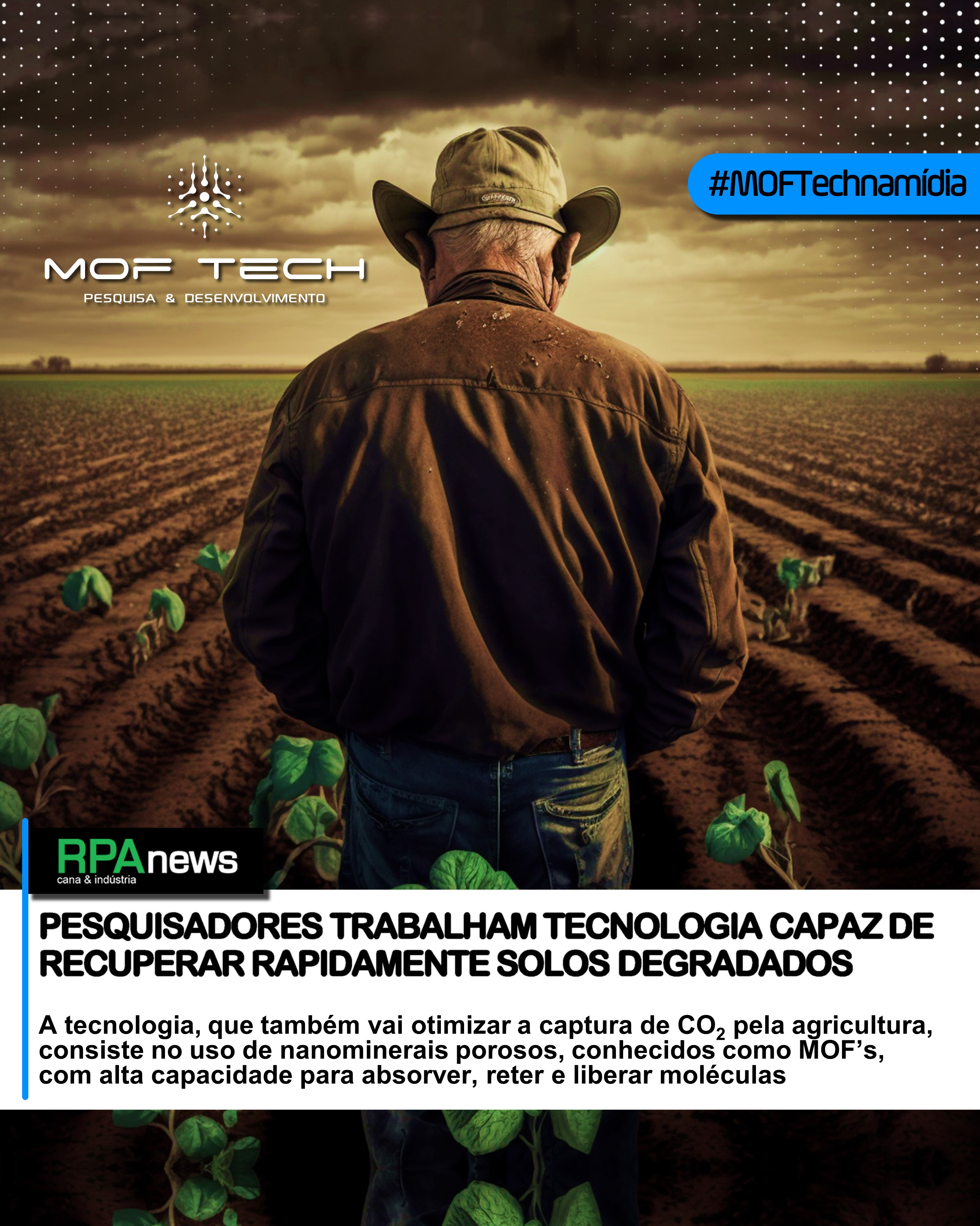
MOF TECH P&D in the Media

Coverage and Recognition

MOF TECH P&D's technology has been featured in specialized outlets,
research centers and TV programs dedicated to agribusiness.

Our Team

The People Behind
MOF TECH P&D

We combine more than 20 years of cutting-edge scientific research
with an entrepreneurial vision and market ambition.

DS
Dr. Dagoberto Silva
Founder & CEO
PhD in Nanotechnology with extensive experience in research and development of new materials. As CEO of MOF TECH P&D, he applies more than 20 years of scientific expertise to drive the transition from science to technology, intellectual property assets and market value.
🔬
Research Network
USP · UNESP · Partners
A multidisciplinary team covering advanced chemistry, nanomaterials, soil science and tropical agronomy — at Brazil's best universities and research centers.
Next Steps

Ready to Be Part of the
Soil Revolution?

We are a pre-seed startup looking for partners and investors who believe cutting-edge science can — and should — solve the biggest challenges in global agriculture.

📍 Ribeirão Preto, SP, Brazil  ·  🌐 moftech.co  ·  📸 @moftech_pd